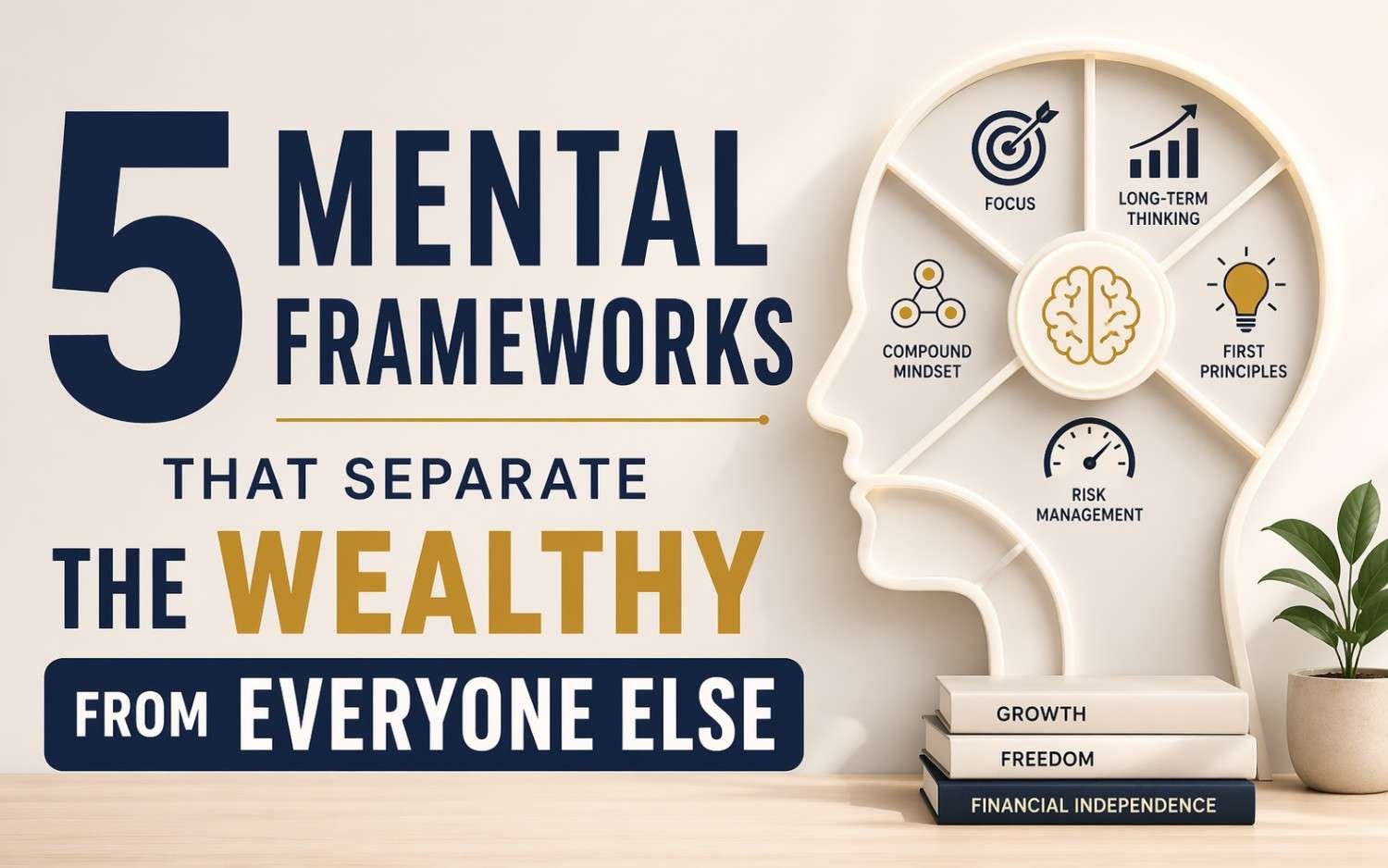
In a world overflowing with personal finance advice—50/30/20 rules, mutual fund comparisons, SIP calculators, and “buy low, sell high” mantras—why do so few people actually build real wealth?
Because knowledge isn’t the gap. Mindset is.
In his viral video “Not Just Another Personal Finance Video,” Ankur Warikoo (warikoo) distills the real difference between the average person and the wealthy. Drawing from years of observing self-made billionaires, his own entrepreneurial journey, and deep reflection, he shares five powerful psychological frameworks that go far beyond technical finance. These are the invisible systems that make one decision compound into lifelong freedom.
If you’ve ever felt stuck despite “knowing what to do” with money, this is for you.
1. Next Order Thinking (Think Like a Chess Grandmaster)
Most people evaluate decisions only on immediate outcomes. Wealthy people play 2–6 moves ahead.
Example from the video:
Taking a home loan feels smart—EMI is “only” ₹15,000–25,000, and you get a tax break. But Warikoo points out the hidden second-, third-, and fourth-order effects: fixed monthly obligations lock you into a salary-dependent job for 10–15 years. Suddenly, switching careers, taking a risk, or starting a business becomes terrifying because you cannot afford to miss even one EMI.
This single decision quietly kills your risk appetite for over a decade.
Practical takeaway:
Before any big financial move (loan, car purchase, job switch), ask:
- What are the second-order consequences?
- Third? Fourth?
- How does this decision limit my future options?
Systems thinking turns one choice into multiple positive outcomes.
2. The Asymmetric Risk-Reward Model
We’ve been taught that higher returns require higher risk. Wealthy people hunt for bets where the upside is disproportionately larger than the downside.
In a corporate job, taking a risky project or moving to a new country might give you a 10–20% increment. Linear growth.
But quitting to build a side business, investing in yourself, or betting on a high-conviction idea can create exponential upside—with the downside often limited to “I go back to a job.”
Warikoo notes that the billionaires he knows came from humble backgrounds. Once their basic survival was secure (no hunger, no poverty), they started playing the game like a casino—maximizing upside while the floor was already protected.
Practical takeaway:
Stop optimizing for “safe” linear growth. Start hunting for asymmetric opportunities where failure costs you little but success changes everything.
3. Antifragility – Getting Stronger from Chaos
Popularized by Nassim Nicholas Taleb in Antifragile, this concept changed Warikoo’s life during his startup struggles (he read the book in 2013–14).
Fragile things break under stress.
Resilient things stay the same.
Antifragile things get stronger.
Market crashes? Opportunity.
Business failure? Lesson that hardens you.
Emergency expense? Forces better planning.
Warikoo’s decade of startup setbacks didn’t break him—they made him mentally unshakeable. Today, nothing phases him the way it used to.
Practical takeaway:
When life throws volatility at you, don’t just survive it. Ask: “What is this teaching me?” Reframe every obstacle as a strength-building workout.
4. Compound Interest… But for Skills, Learning, and Consistency
Everyone talks about compound interest on money. Few apply it to behavior.
The difference between the wealthy and the rest? The wealthy are willing to do the same “boring” thing repeatedly for years.
Warikoo’s own story is proof: In 2020, amid the COVID boom, he started creating content. He didn’t chase trends or go viral overnight. He created 500 long-form videos and 1,500 short videos—consistently, even when it felt repetitive. Today he has millions of followers and multiple bestselling books.
99% of people chase novelty. The wealthy compound through boredom.
Practical takeaway:
Pick one skill, one habit, or one asset (content, investing, fitness, relationships) and commit to daily repetition. The magic isn’t in the excitement—it’s in the compounding.
5. Mastering Emotions Around Money
Money decisions are rarely logical. They’re emotional.
We buy cars, gadgets, or experiences for status, validation, or FOMO—not need. Markets swing wildly on news and fear. Most people react emotionally and sell low or buy high.
Wealthy people zoom out. They treat investing like college: there will be bad days, tough semesters, and moments of doubt—but you don’t drop out every time you feel low. You stay for the long-term degree (freedom).
Practical takeaway:
Separate emotional spending from practical spending. When markets crash or news screams, ask: “Does this change my long-term thesis?” If not, stay the course.
The Real Wealth Formula
Warikoo’s core message is crystal clear:
Technical knowledge (which mutual fund, which SIP, 50/30/20 rule) is freely available on YouTube.
What separates the wealthy is the mental operating system behind every decision.
These five frameworks create a flywheel: one smart decision leads to better opportunities, stronger resilience, compounded skills, and emotional control—which leads to even better decisions.
It doesn’t just change your bank balance. It changes your entire life.
Ready to Build This Mindset?
If you’re in your 20s or early 30s and feel confused about career, money, or the next step, Warikoo’s latest book Build An Epic Career is the perfect next read. It gives you 15 practical career tools, mindset shifts, and frameworks to avoid common mistakes and design a life of impact.
Watch the full video here: Not Just Another Personal Finance Video
Which of these five frameworks resonated with you the most? Drop your biggest takeaway in the comments—I’d love to hear how you’re planning to apply it.
Stay epic. Build wealth that lasts.